
Someone hard to buy for
A name on a mug won't help if they already own six. Here's what actually works for someone genuinely hard to buy for.
Read the guide →Guides on techniques, deadlines and the mistakes that ruin a good idea, written for people who need to choose well and get on with it.
Browse the gift guidesChoose well by starting with the specific problem in front of you. Each path below leads to a focused guide.
A name on a mug won't help if they already own six. Here's what actually works for someone genuinely hard to buy for.
Read the guide →A first house, a fortieth birthday, a retirement: these carry more weight than a routine birthday, and the gift should match that.
See the milestone guide →Personalisation adds a production step most people don't budget for. Lead times for engraving, embroidery or printing vary, and peak periods add more.
Check your lead time →A misspelled name can't be fixed once it's engraved
Ask yourself: have you checked the name and date against a document before approving the proof?
Get names and dates rightThe technique decides whether the gift survives daily use
Ask: will this item be washed, handled or left in the sun, and does the technique you've chosen actually withstand that?
Compare personalisation techniquesPersonalisation adds a production step most buyers don't budget for
Ask: does the lead time you were quoted include that step, or only standard dispatch?
Check realistic lead timesA personalised item is only a keepsake if it outlives its use
Ask: will the recipient still own this object in five years, or is it consumable by design?
Read gifts for hard-to-buy-for peopleApproving a proof means accepting the risk of the error in it
Ask: have you read every character aloud?
Judge quality before you orderPersonalising a generic detail doesn't make a gift more thoughtful
Ask: does this detail mean something specific to them, or could it apply to almost anyone?
See when personalisation helps or ruins a gift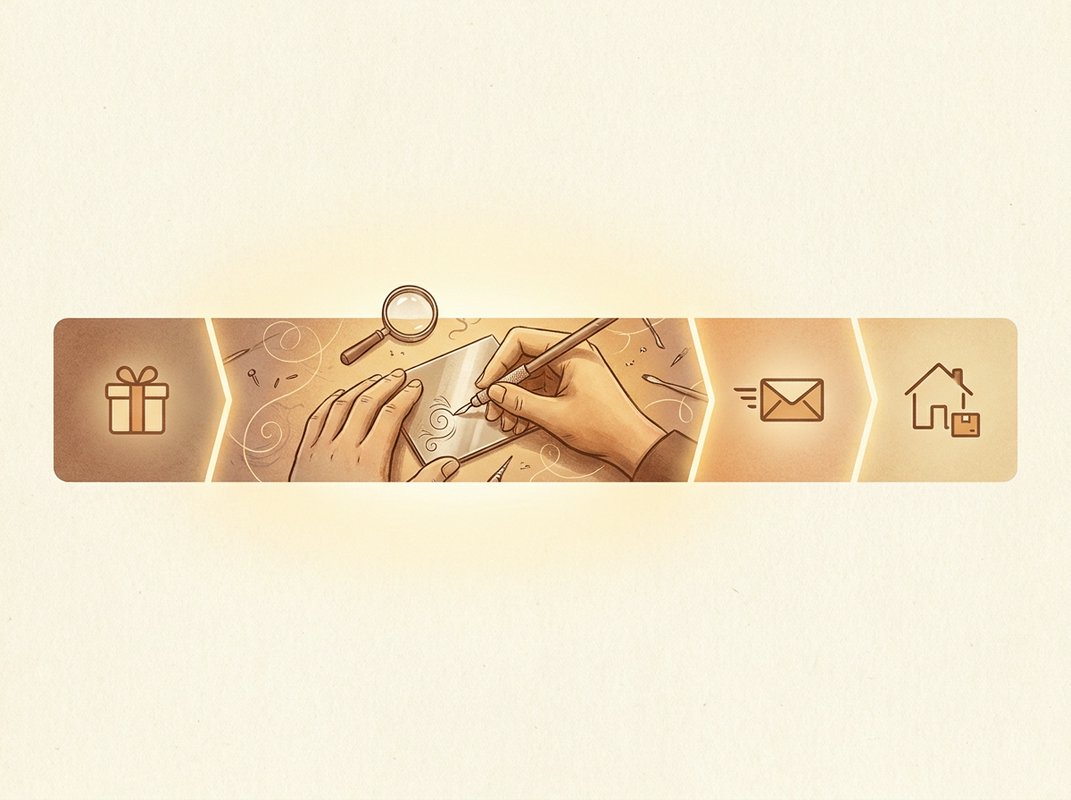
A personalised item does not begin as the thing you are buying. It begins as a standard product that then goes through a separate process: a laser cutting into steel, a needle stitching a monogram, a machine pressing foil onto card. That process sits after the base product exists and before it ships, and it is not included in the delivery time quoted for the standard version of the same item.
Most suppliers also build in a proof stage: a preview of the design, sent for you to check and approve before the personalisation step runs. Nothing gets engraved, embroidered or printed until you have signed that off, so the days between the proof landing in your inbox and you replying with an approval are days added to your order.
This is why the delivery estimate on a product page is often the wrong number to plan around. It usually describes how long the base item takes to make or source. Ask a supplier for the lead time on the personalised version specifically, and ask what happens to that date if the proof needs a second round of changes.
Where a fixed date matters, such as a wedding or a retirement with a set send-by day, work backwards from that date. Leaving enough time sets out how to do that for different techniques, and getting names, dates and spellings right covers the proof-checking step itself, since a second proof round is the most common reason a personalised order overruns.
Laser engraving, embroidery, foil blocking and printing all wear differently once the gift is out of the box, so it helps to know which one fits your recipient and your deadline before you put in an order.